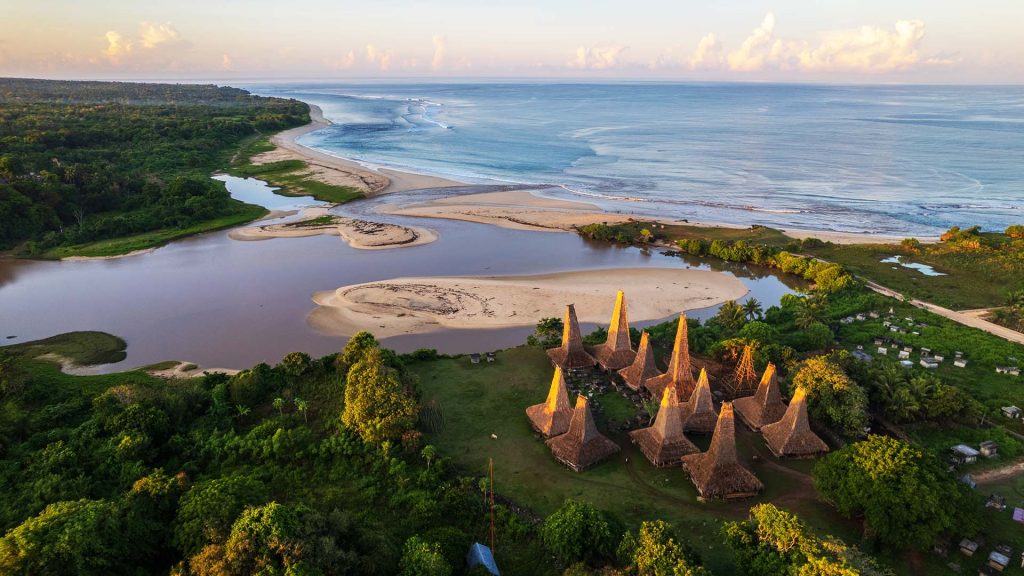
The propeller plane out of Denpasar is barely an hour in the air, and for most of it there is nothing below but the Sunda Sea going from blue to a harder blue. Then Sumba arrives all at once, brown and enormous, twice the size of Bali and holding a fraction of the people. In August the island is the colour of a lion. The rains left in March and will not return until December, and in the long dry between, the grass on the hills goes gold and then goes pale, and the sandalwood ponies stand in it up to their bellies. We land at Tambolaka, on the western end, where the airport is a strip and a shed, and the heat comes through the aircraft door with real weight.
I have been flying into Sumba for World Travel Magazine since before the first serious hotel, and the drive west has changed less than the conversations inside the cars. The road still throws you around. The villages still gather under peaked thatch roofs that rise like ships’ prows, some of them twenty-five metres tall, built to hold the spirits of the ancestors close to the household. What is new is the man in my passenger seat with a laminated map on his knees.
His name is Yohanes. He grew up an hour south of here, drove a van for one of the resorts for six years, and now he brokers land. The map is his own work, marked in four colours: what has sold, what is under offer, what the owners will not part with, and the two long ribbons of beachfront that everyone is circling. He taps the coast between the properties near Kodi, on the west shore where the sunsets land in the water.
“Ten years ago nobody wanted this,” he says, not looking up. “It was buffalo and salt. Now a French couple built a beautiful thing on it, and every month someone comes off that plane with drawings.” He smiles at the windscreen. “The island has not decided yet what it wants to be. But it is deciding. You can watch it happen from a car.”
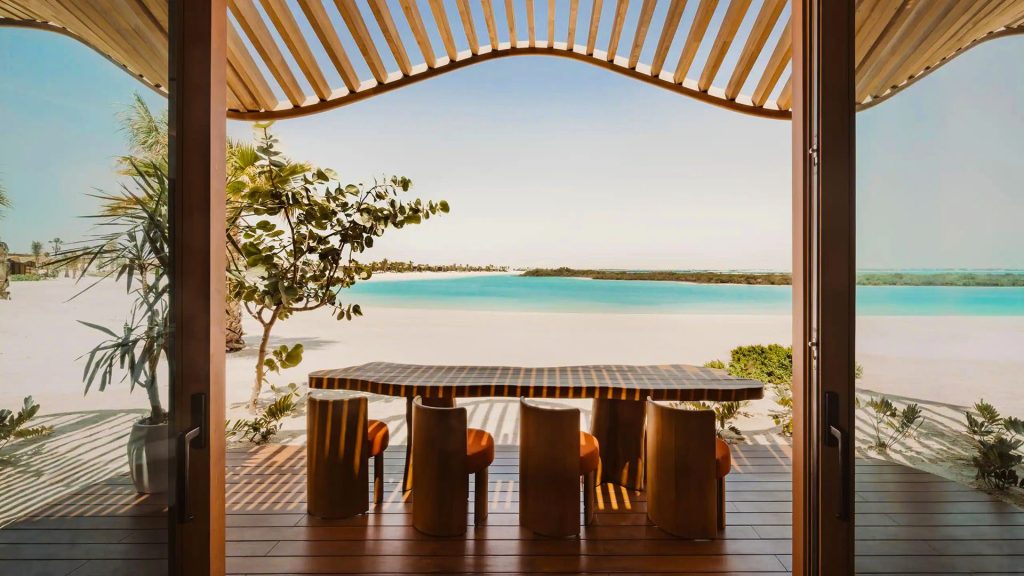
The beautiful thing he means is Cap Karoso, and it is the reason I keep coming back to argue with the brochures. It opened on the west coast in 2023, forty rooms and twenty villas of low concrete and local timber set above a farm, the work of a Jakarta firm that understood the island well enough to borrow the shape of a Sumbanese village for the spa and resist copying it everywhere else. There is a restaurant, Julang, that flies in guest chefs to cook what the three-hectare farm grows, and it holds a Michelin Key, which on an island with one strip and a shed is its own kind of statement. It is, right now, the place to stay. Next door, ARYA Sumba has already opened its doors, and the twenty villas Cap Karoso sells to private owners are the thing that is coming, the first bricks of the ribbon Yohanes has coloured in.
Here is the honest ledger, because Sumba punishes people who arrive believing the pictures. The flights are propeller planes that fill and empty on their own schedule, and a full one will move a half-empty one to a later slot without apology. The roads are long and hard, and a drive that looks like forty minutes is two hours. This is a malaria zone, genuinely, so you talk to a doctor before you come and you carry good repellent and use it at dusk. English thins out fast beyond the hotel gate, and a translation app earns its place in your pocket. None of this is a complaint. It is the toll on the bridge, and the toll is exactly what has kept the place the way the drawings promise it still is.
Now the correction. The story the wider world tells about Sumba is a surf story, and it is only half true. That story belongs to the south coast, to NIHI and the long left-hand wave the surfers came for decades ago, and it is real and it is wonderful and it is not this coast. The west near Kodi is a different animal. In August the southeast wind is up and the swell comes with it, and the turquoise glass in the press shots is a dawn phenomenon, an hour after sunrise before the wind finds the bay. Come expecting a mirror and you will spend your afternoons puzzled. Come understanding the wind and you will plan your swims for morning and your long lunches for when the sea turns to hammered metal in the glare, which is its own beauty and photographs badly, which is precisely why it survives.
The deeper correction is the one the renders cannot make. Sumba is not an empty page. It is a working island of some 800,000 people with a religion older than most of the ones you have heard of, called Marapu, that keeps the megalithic stone tombs in the villages and the ancestors in the roof beams and the whole calendar tied to obligations the hotels do not print on the activity sheet. It has an economy woven, literally, on backstrap looms, the ikat cloth that takes months and means something specific in every motif. The luxury here is not the beach club that could sit on any warm coast in the world. The luxury is the severity of the place, the gold grass and the hard light and the ponies and the silence at the tombs, and the fact that a living culture is still the loudest thing in the room. A resort that forgets that is building the wrong island.
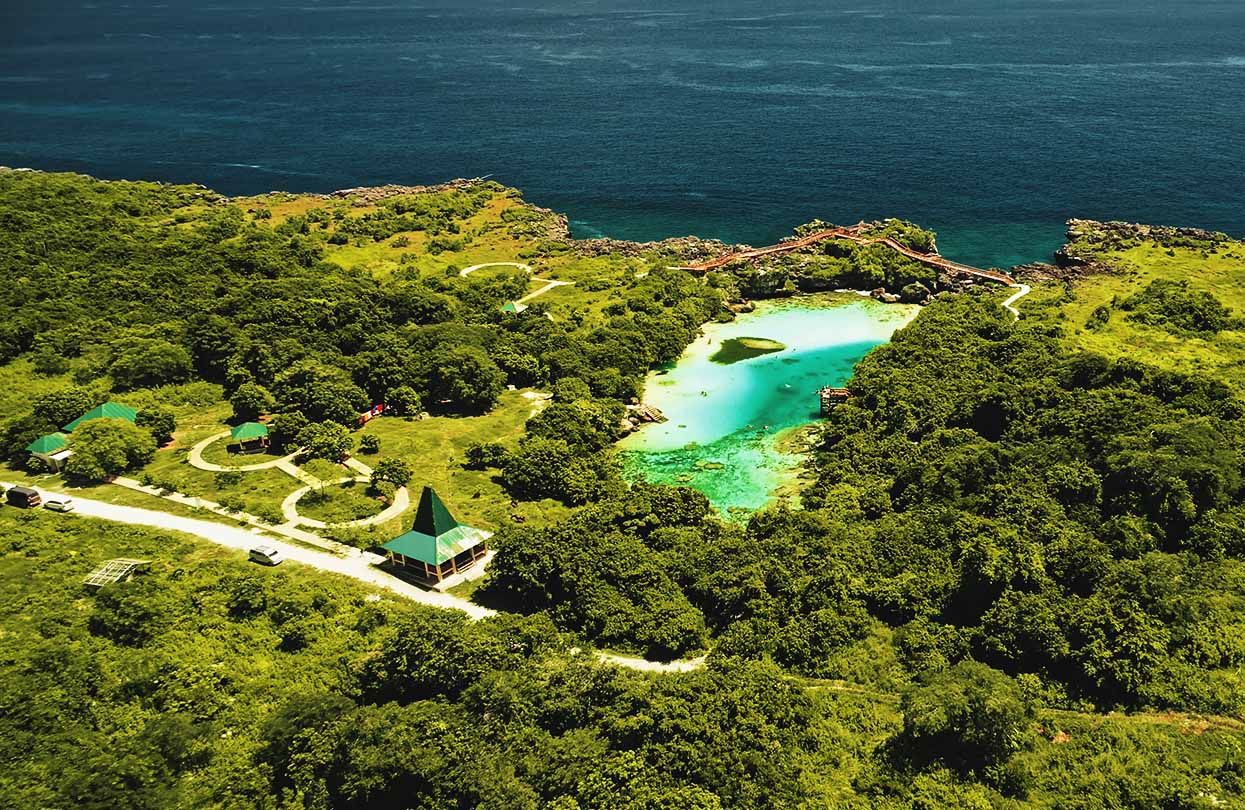
Lake Weekuri at Sumba Island, Image by Goinyk Production, Shutterstock
So what happens next. My three-year read is straightforward, because Yohanes has already drawn it for me. The ribbon fills. The gap between Cap Karoso and ARYA closes with two or three more design-literate properties, most of them low and quiet because that is what the buyers coming off the plane with drawings actually want. Tambolaka gets a second daily flight and a longer queue at the shed. The per-metre prices Yohanes quotes, still absurdly gentle by any Southeast Asian standard, double and then double again.
The ten-year read is where it gets interesting, and where the island genuinely has not decided. There is a version of Sumba that keeps its nerve: a handful of serious low-rise places strung along the west coast, Marapu and the weavers still setting the terms, the road improved but the scale never breaking the tree line, an island that took Bali’s mistakes as a syllabus rather than a template. And there is the other version, the one where the ribbon hardens into a strip and the ponies lose the beach and the tombs end up landscaped into someone’s water feature. The first version is still winnable in 2026. I have watched enough coastlines lose it to know the window is narrow and closing.
Which is the whole point of going now. Go in the next two or three dry seasons, August through October, early enough that the story is still being written and late enough that the sheets are already excellent, because Cap Karoso solved the sheets on day one. Fly into Waingapu in the east and out of Tambolaka in the west if you can, and give the island seven days, because Sumba is cruel to the three-day traveller who spends it all in a vehicle. Go while the road is still a little rude to you. That rudeness is the last thing keeping the place honest.
On my final evening Yohanes drove me to the stretch of sand he calls, without irony, the sunset plot. It is coloured “under offer” on his map. A boy was riding a sandalwood pony bareback along the tideline, the way boys have done here for a thousand years, and the pony’s hooves left prints that ran right over a surveyor’s wooden peg someone had hammered into the beach that week. Further along, a woman had spread a length of ikat over the flat top of a stone tomb to dry in the wind, indigo going stiff in the last of the light. None of it knew it had a price per square metre yet. I stood there long enough to fix it, the boy and the pony and the cloth on the tomb and the peg in the sand, because I do not think all four of those things will still share that beach in ten years. I would like to be wrong. Either way, I was there this week, and I wrote it down.
Christine Lee writes Local Time, Seasonal Drift, and the field dispatches for World Travel Magazine. She is based in Phuket and has been covering the region for twelve years. She was there last week. She’ll tell you what’s actually changed. ◼
Subscribe to the latest edition now by clicking here.
© This article was first published in Aug-Sept-Oct 2026 edition of World Travel Magazine.