The Red Sea, Audited. On 15 May, Miraval opens its first resort outside the United States, on Shura Island. Five days later, Four Seasons opens next door. Through June, July and August, three more go live up the coast at AMAALA: Four Seasons, then Six Senses, then Rosewood, the last of them taking bookings roughly two months ahead of schedule. Five ultra-luxury openings in ninety days. The Saudi Red Sea has stopped being a rendering you evaluate on faith and become a portfolio you can actually book.
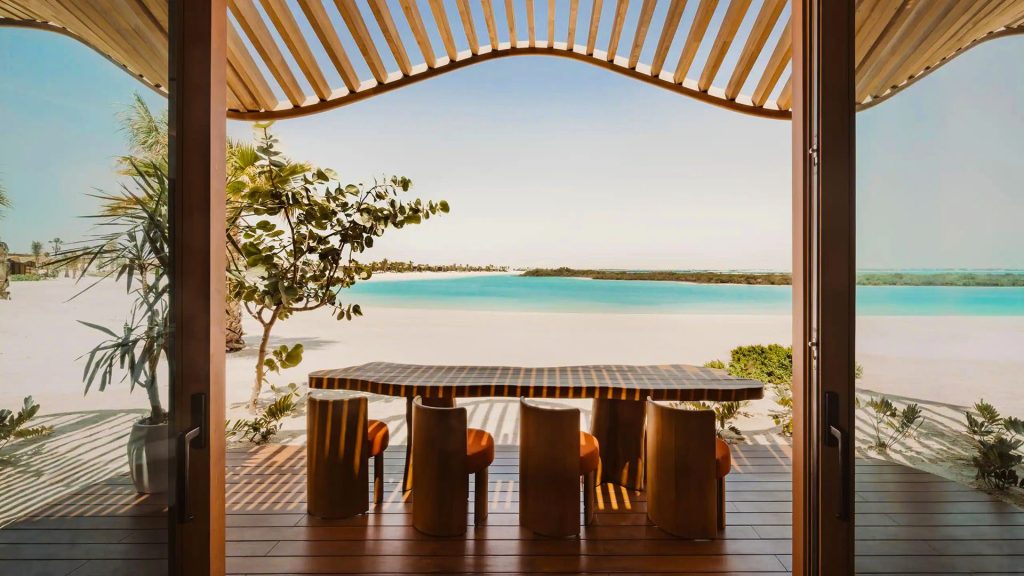
Eleven hotels now operate along the stretch Red Sea Global runs between Umluj and Al Wajh, and the number is itself the news. Six Senses Southern Dunes has been open inland since 2023. On the Ummahat islands sit The St. Regis Red Sea Resort, its ninety villas by Kengo Kuma, and Nujuma, a Ritz-Carlton Reserve, its shell-shaped pods by Foster and Partners. Shebara floats on its own island in mirrored steel; Desert Rock is cut into the Hijaz. On Shura, the hub island, five names are live: The Red Sea EDITION, SLS, InterContinental, Miraval and Four Seasons. Add the mainland’s Turtle Bay. Two years ago this list had one entry.
Here is the pattern beneath the ribbon-cuttings, and it runs opposite to what a launch usually signals. Red Sea Global has written a hard ceiling into its own model: no more than one million visitors a year at The Red Sea, and no more than 500,000 at AMAALA, the wellness sister up the coast. Development is confined to under one percent of the destination’s 28,000 square kilometres. This is a place engineered for scarcity. Yet supply is arriving faster than the market has found it. When Four Seasons opens with rates visibly below where a Four Seasons on a private Red Sea beach should sit, that is not generosity; it is a company filling rooms in a launch window before the cap begins to bite. The arithmetic is worth acting on. The softest prices this coastline will ever show are the ones on screen right now.
The second signal is quieter and more structural, and it is the one worth carrying home. Look at what AMAALA is actually assembling. Six Senses opened in July with longevity and recovery facilities. Rosewood arrived in August with its Asaya spa. Still to come are Equinox’s first hotel in the region, the family-oriented Jayasom, and, in 2027, Clinique La Prairie’s first resort outside Switzerland, a longevity clinic with a beach. Note that date. It is 2027, not this year, and anyone briefed on an earlier timeline should quietly correct their notes. Meanwhile the resorts pour no wine. No licensed venue in the Kingdom serves alcohol to tourists, official denials of imminent change included, and the Red Sea menus run to juice, coffee and mocktails. Set those two facts side by side and a thesis surfaces: this coastline is being built as a sober, longevity-coded luxury geography, priced for people who increasingly treat sleep, bloodwork and a genuinely dark sky as the trophies worth collecting. That is structure, not fashion. Fashion is loud. This is a bet on where status is heading, poured in concrete and solar glass.
The ledger, stated plainly, because in a place this young the gap between open and opening is the entire game.
Open and bookable now: the eleven at The Red Sea, plus AMAALA’s Four Seasons, Six Senses and Rosewood. Shura Links, the Foster and Partners island golf course with a LEED Platinum clubhouse, has been taking tee times since last September.
Announced through the end of 2026: the balance of Shura’s eleven, which means Grand Hyatt, the 430-key resort shaped from the air like a coral bloom, alongside Jumeirah, Fairmont, Faena and Raffles, plus Rosewood on Shura. At AMAALA, Equinox, Jayasom, the Mykonos import Nammos and a 390-key Ritz-Carlton are slated before year-end.
Opening 2027 and beyond: Clinique La Prairie at AMAALA, and Laheq, Red Sea Global’s first residential island, in 2028.
Treat every name in the second and third groups as announced rather than arrived. This list moves monthly, and the honest reader keeps that caveat close.
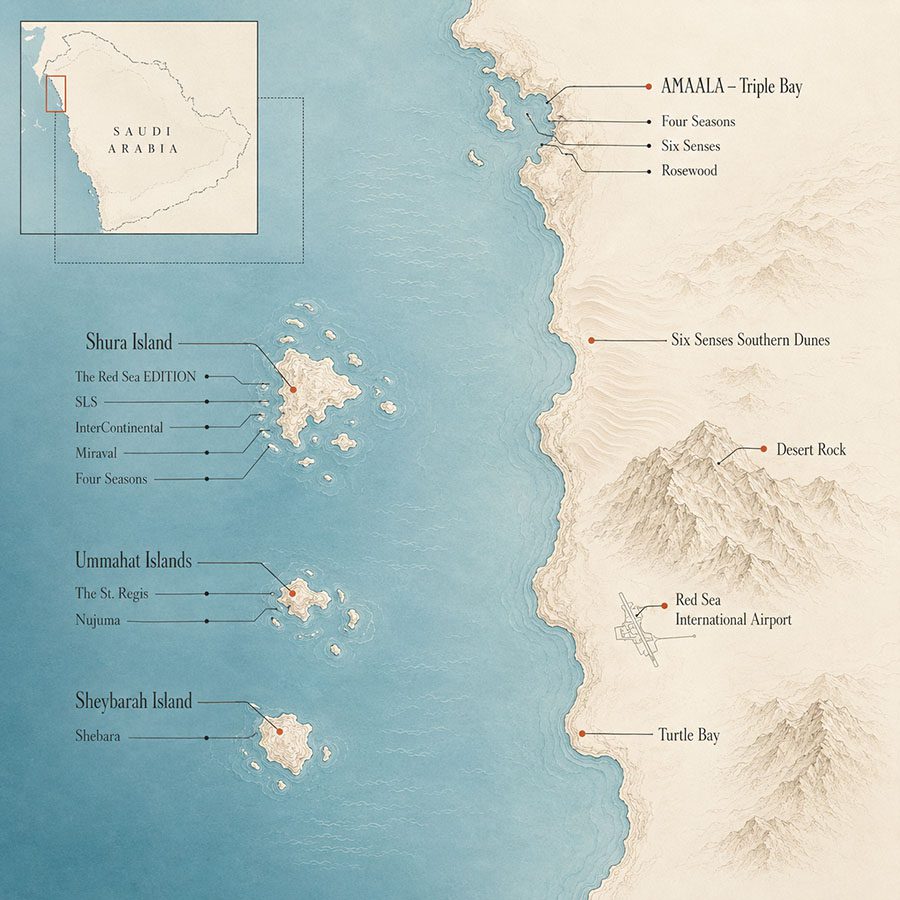
Illustration of The Red Sea development
What separates this from vapour is the plumbing, and the plumbing is real. Red Sea International, a Foster and Partners airport, has flown scheduled services since September 2023. It sits within three hours’ flying time of roughly 250 million people and takes direct routes from Riyadh, Jeddah, Dammam and Dubai, with more appearing as capacity grows. The destination runs on solar, more than 700,000 panels, toward a zero-carbon operating target. The islands have no roads. You reach Nujuma or St. Regis by seaplane in about 25 minutes or by boat in 45, transferring at the airport into a Lucid electric car, and that friction is the point: it is what keeps a cap of one million meaningful rather than notional.
On price, the bands are now legible enough to plan around. The most reachable way in runs through the Shura brand hotels, where a room at the EDITION or SLS opens the destination without opening a war chest. The island tier steps up hard. The St. Regis Red Sea starts near 1,866 dollars a night for a villa and settles into the low-to-mid two thousands for live dates. The ceiling is Nujuma, one of only a handful of Ritz-Carlton Reserves on earth, which opened as the most expensive hotel in the region: entry villas above 2,200 dollars, and a three-bedroom Royal villa clearing 20,000 dollars a night. Nujuma outpricing the Burj Al Arab is not trivia. It is a statement of where the Kingdom intends to sit on the global shelf, and it has been priced there on purpose.
Two external marks are worth logging without inflating them. Forbes Travel Guide recognised the destination this year as the first in the world to earn a portfolio-wide luxury rating, and Shebara made TIME’s Greatest Places list. Read those as evidence that the standard is holding across properties, which is the harder thing to achieve than one showpiece opening. Read them as data, not applause.
A practical note, delivered flat. Dress is modest in public areas, but the private beaches and pools run to ordinary swimwear; cover through the common spaces, skip the toplessness, and you will not think about it again. Unmarried couples now share rooms without proving anything to anyone. None of this is friction for anyone who has done the Maldives or the Seychelles. All of it is worth knowing before the seaplane.
So the verdict, which is the reason you are reading World Travel Magazine rather than a booking engine.
Go now if you collect firsts and value emptiness over fabric. The Ummahat islands are as quiet as they will ever be, the opening rates are soft, and being early to Nujuma or Shebara still counts at the dinners where such things are counted. This is the window for the traveller who needs to arrive before the place does, and it does not reopen once the cap starts working.
Go in roughly eighteen months if you want the destination whole. By late 2027 Shura’s eleven should all be live, AMAALA’s wellness cluster complete but for its final names, Clinique La Prairie finally open, and the one thing every new destination lacks at launch will have started to set: a social and dining fabric that exists independent of your own hotel. For the guest whose reason for going is the recovery itself, the longevity floor at AMAALA, the sober weeks, the sleep, that eighteen-month wait is the difference between a resort stay and a genuine reset.
And the caveat, because an audit without one is a brochure. The dining depth is not there yet; venture beyond your resort and the options thin fast. Several of the newest properties are still photographed largely in renderings, which is a courteous way of saying the finish is young. The texture that makes a destination feel inevitable, the second-generation restaurants, the staff who have worked a room for three seasons, the reputation that travels by word of mouth rather than press release, is the single thing money cannot open early. It accrues. The Red Sea has bought everything except time, and time is the one line item it cannot expedite.
So is the Red Sea worth it? Go now for the emptiness or in two years for the fabric, but not in the eighteen months between, when it will be neither.
Zara Mehta writes Unmapped and Takeoff for World Travel Magazine, reading the signals in luxury travel while they are still signals. She files from wherever the next thing is opening. ◼
Subscribe to the latest edition now by clicking here.
© This article was first published in Aug-Sept-Oct 2026 edition of World Travel Magazine.