This September, the most valuable bottle in the world’s great cellars is the one with your fingerprints on it.
The Vintage You Made. The cold comes first. Not the cold of a hotel corridor at dawn, engineered and odourless, but a living cold that has been lying in the vineyard rows all night and rises now off the limestone as the first grey light finds the Côte de Beaune. It smells of wet stone and bruised leaf and something sweeter underneath, the sugar already leaving the fruit and turning to scent on the air. You are standing in a walled vineyard in Pommard at six in the morning in a borrowed jacket, holding a pair of secateurs you do not yet know how to use, and the woman beside you, who has done this every September of her working life, is watching your hands. She is not unkind. She is simply waiting to see whether you understand what you are about to touch.
This is the hour nobody photographs. The estates that matter do not stage it, because it cannot be staged. The light does its slow work along the slope, the pickers move down the rows without speaking, and the fruit that has spent a hundred and ten days becoming itself waits to be taken at exactly the moment it is ready and no other. In 2026 that moment has come early. The season ran hot and generous through the spring, the vines a full week ahead of even 2020, which until now held the record in living memory for the earliest picking in the Hospices de Beaune ledgers. The crémant fruit was already coming off around the seventh of August; the still whites a week behind it; the young reds only days after that. By the time this magazine reaches the tables where it is read, the vendange across Burgundy, Champagne, Tuscany and the Douro will be finishing or finished. Which is the first thing worth saying plainly. If you want the year 2026 to carry your name, you are close to the last of the light.
For most of the history of luxury travel, the destination arrived complete. You were received. The bed was turned down, the terrace was set, the sommelier appeared at your elbow with something rare and poured it and told you why it mattered, and your role, the whole of your role, was to be the person for whom this had been prepared. The great hotels perfected the art of anticipating you so thoroughly that you never had to want anything twice. It was beautiful, and it was passive, and a certain kind of traveller has quietly grown tired of it. They have been given everything. What they have not been given, until recently, is the chance to make something that outlasts the trip; to come home not with an object that was sold to them but with a thing that did not exist in the world until their hands helped bring it into being. The estates have noticed. And so the most interesting doors in European wine now open not onto a tasting room but onto a sorting table, and the person on the other side of the table hands you an apron instead of a glass.

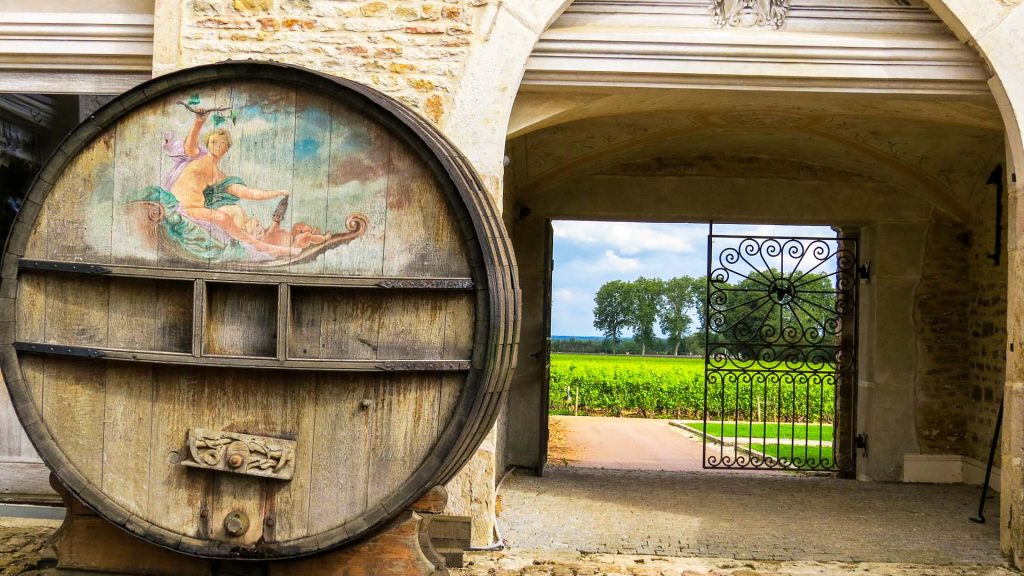
Vincent Girardin Pommard Burgundy wine on display, image by The Image Party, Shutterstock
Château de Pommard sits behind its long wall as it has since 1726, its twenty hectares of Clos Marey-Monge held whole and unbroken, a single walled vineyard of a kind that has become almost mythical in a region where inheritance has diced the land into ribbons. Most visitors come for the tasting, and the tasting is serious; the advisors are trained through the Wine and Spirit Education Trust, and they will teach you to read a wine by its colour and its weight and the length of its finish long after you have swallowed. But in the week of the picking the estate opens a narrower door. You go into the rows before the day is warm. You cut fruit, badly at first and then less badly, and you carry it in, and you stand at the sorting table where the bunches come past on the belt and you learn, by being corrected, which berries stay and which are lifted out. At the end you sit down and eat with the people who did the work, the long unhurried lunch of a French estate at harvest, bread and something braised and the estate’s own wine poured without ceremony because everyone at the table has earned it. And somewhere in the afternoon, when the light has gone gold and slow, someone brings out the pressing. It is cloudy and sweet and alive and it tastes of nothing you will find in a bottle, because it is not wine yet, it is the idea of wine. The winemaker watches you drink it. Then, and this is the moment the whole day has been quietly building toward, he asks you what you think.
That question is the hinge. Up to that point you have been a guest, well looked after, gently instructed, held at the comfortable distance that hospitality keeps. The question closes the distance. It assumes you have a palate worth consulting and an opinion worth hearing, and once you have answered it, haltingly, you are no longer only a visitor to the year. You have a stake in how it turns out. This is the graduation that World Travel Magazine has watched reshape the top of the market over the last two seasons, the movement of the discerning from the audience to the floor: the traveller who once wanted the best seat now wants the apron, and the estates that understand this are the ones writing the next decade of what luxury means.
North of Burgundy, in the chalk country around Épernay, the same shift wears different clothes. Champagne has always guarded its mysteries more jealously than still-wine country, but the grower houses, the small domaines that farm their own fruit and bottle their own name, have become the places where the curious are let closest to the work. Leclerc Briant, in Épernay since the middle of the last century and farming its fourteen hectares organically and in parts biodynamically, was bottling single vineyards in the nineteen-seventies when the great houses still blended everything into a house style, and it thinks about wine as a living and slightly mysterious thing. Its cellar master, Hervé Jestin, is among the most quietly respected oenologists in the region, a man who talks about energy and balance in ways that would sound eccentric if the wines in the glass did not so completely justify him. To spend a morning in the September fog with a house like this is to understand that sparkling wine is an act of patience measured in years, that the bottle laid down now will not be ready to speak until the picker who cut its fruit has half forgotten the cold of the morning she cut it. The house’s most talked-about cuvée spent its second fermentation in the sea. Nothing here is in a hurry, and nothing here pretends to be.
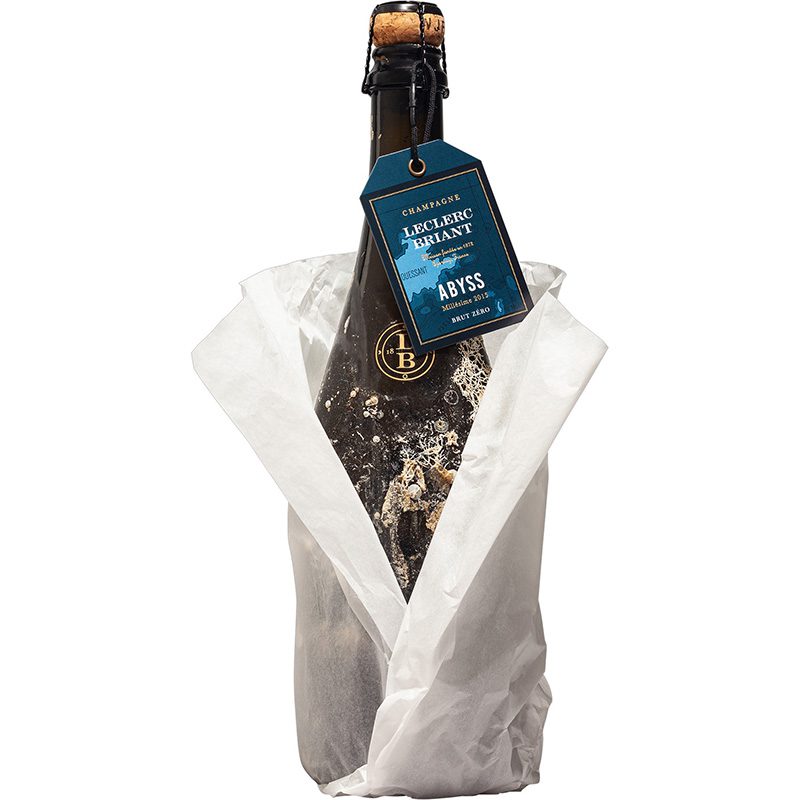
Leclerc Briant
Then the map tilts south and west, down to where the Douro cuts its gorge through the schist, and the whole grammar of harvest changes. In Portugal the picking comes later; the Douro vintage in 2026 runs from around the tenth of September to the first week of October, the fruit ripening slow and dark on terraces so steep that no machine has ever found a way to work them, so that every grape that becomes port has been carried down those walls on a human back. The heat here is a different animal from the crisp cold of the Côte. It sits in the valley all day and releases only reluctantly at night, and the river below holds the last of the light long after the sun has gone off the slopes, a flat pewter ribbon between black hills. You feel the year in your legs before you understand it in your glass.
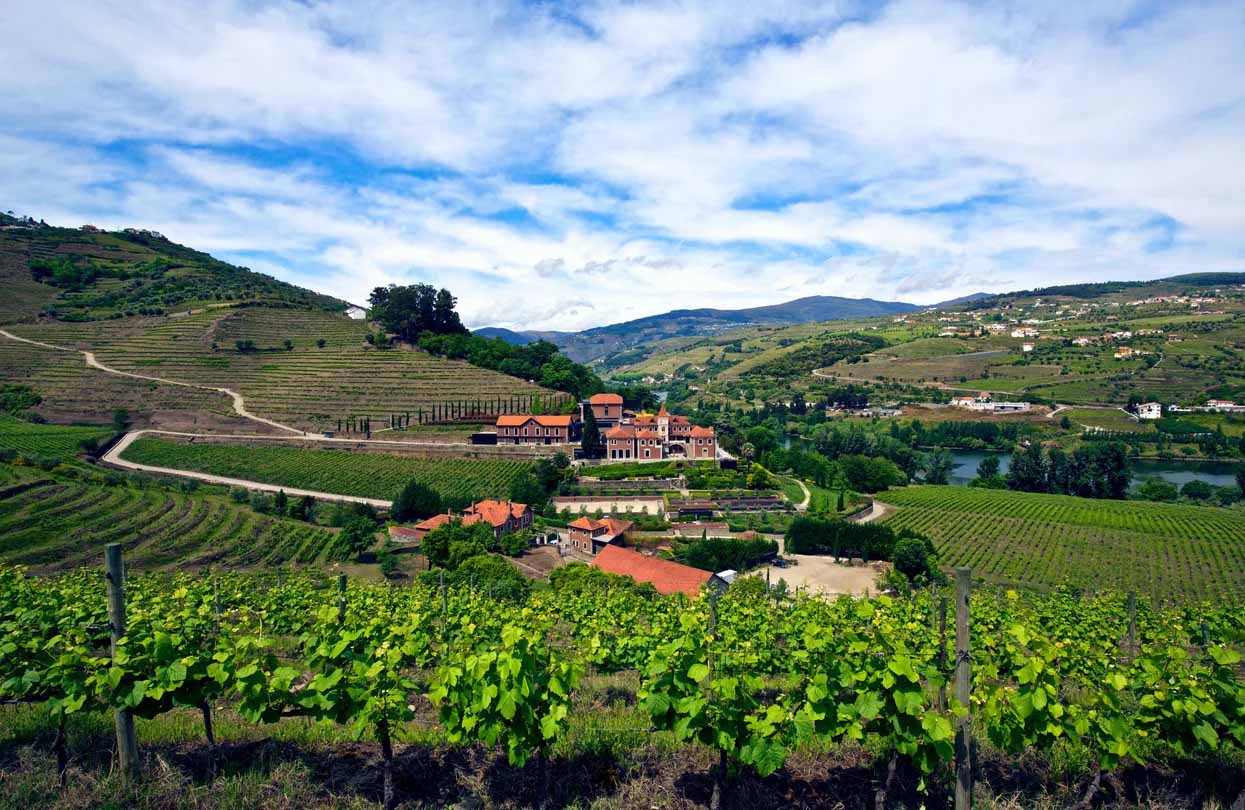
Six Senses Douro Vineyard
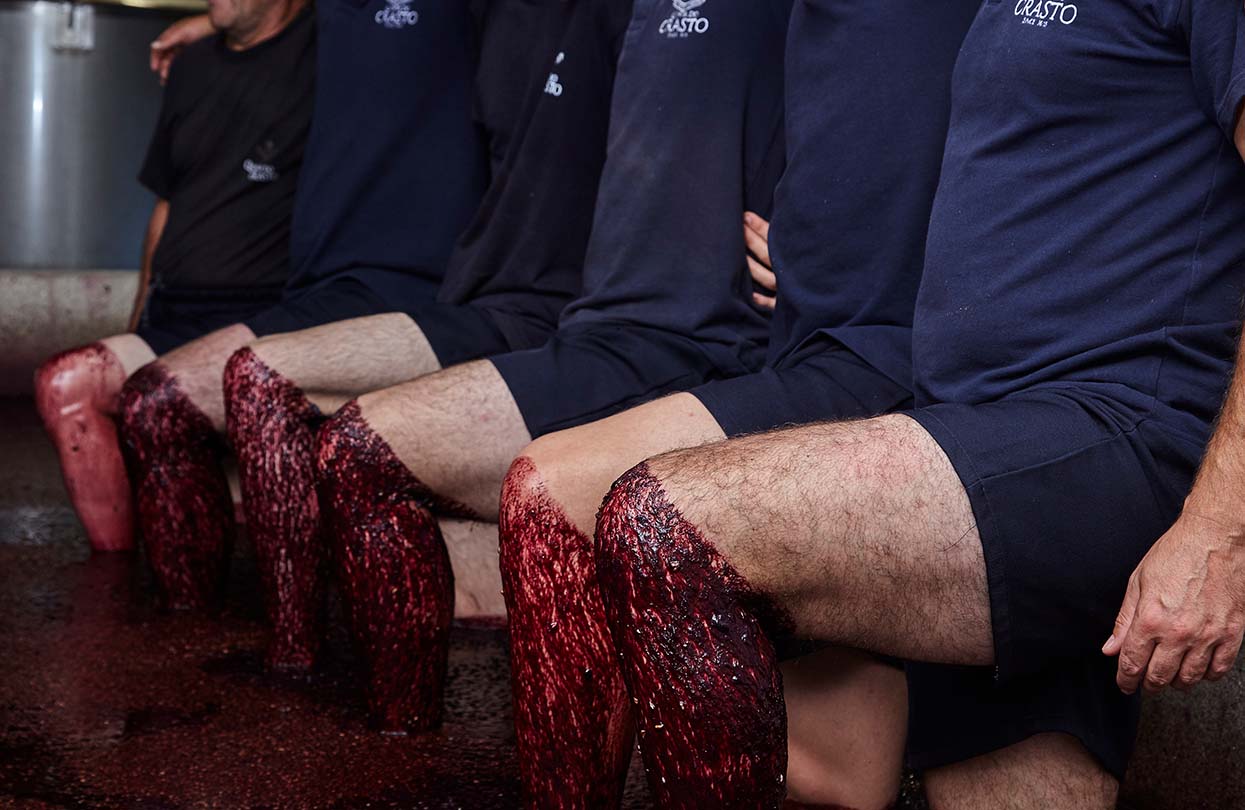
The base for this country is Six Senses Douro Valley, set into a restored nineteenth-century quinta at Vale de Abraão above Lamego, a house that treats stillness as the point of the exercise and lets the valley do the talking. From there the harvest opens up. But the room you want to be in belongs to Quinta do Crasto, on the right bank between Régua and Pinhão, a hundred and thirty-five hectares of estate riding a spur of land above a bend in the river with the water on three sides and a view that has undone better writers than this one. Crasto still makes port the old way, and the old way runs through three granite lagares, shallow open tanks where the fruit is trodden by human feet. The largest tank takes nine tonnes of grapes. The fruit stays four days. And for four hours each of those days a line of perhaps ten people links arms and walks the must down, knee-deep, in a slow marching rhythm that begins as work and, somewhere after the first hour, when the accordion starts and the line finds its step, becomes something older than work.
You should do this at least once before you decide what wine is. The must is warm and faintly resistant, thickening under your feet as the skins give up their colour, and the smell that comes off a working lagar at nightfall, all crushed fruit and warm stone and the sweat of the line, is the smell of the thing being made and not the thing being sold. It is not comfortable. Your legs will remember it for days. And that discomfort, the physical cost of it, is exactly what the polished version of this world has spent a century designing out, which is why finding it again feels less like a tour and more like a confession. You came looking for beauty. You found labour, and the beauty was hiding inside it.
Quinta do Crasto’s Winery
All of this, the cold rows and the sorting table and the trodden lagar, is the front half of a longer arc, and the longer arc is the actual proposition. Because the estates that let you pick are, increasingly, the estates that will let you commission. The private barrel is the quiet centre of the co-creation era, and most of the people who could easily afford one have no idea it exists. The shape of it varies by region and by house, but the essence is consistent: you take not a bottle but a barrel, a single two-hundred-and-twenty-five-litre cask of a specific year, and you follow it. You are consulted on the fruit and the blend. You taste it out of the wood as it evolves, sometimes travelling back to do so, sometimes receiving samples drawn and sent. You name it. You dress it, choosing the label, sometimes commissioning an artist for it in the way Ornellaia has made almost a private language of its Vendemmia d’Artista, where each vintage is given a word and an artwork and a run of large-format bottles that collectors chase around the world. And at the end of the process, two years later, or three, you take delivery of roughly three hundred bottles of a wine that carries a year you were present for and a name that is yours.
Here is where the lyrical has to make room for the numerical, because precision is its own form of respect. A private barrel is not a souvenir, and it is not priced like one. At the accessible end, a boutique programme built around good but not legendary fruit sits in the region of fifteen to twenty-five lakh rupees, the wine included, the residency included, the wait included. Move up to a serious estate in a named appellation, choose grand fruit, ask for the artist and the bespoke everything and the cellar visits across the ageing, and the figure climbs steadily toward and past a crore. These are indicative numbers and they move with the region and the year; the point of stating them is not to quote a price list but to be honest about the order of magnitude, which is the order of magnitude of a small and very good car that you will instead drink, slowly, over the rest of your life, with the people you most want to drink it with.

Quinta do Crasto’s Oak Cellar
And now the part that the impatient will misread as a drawback and the initiated understand as the entire point. It takes years. The barrel you commission in the 2026 vendange, the one whose fruit you helped carry in from the cold, will not come home to you in 2026, or in 2027. It will rest in the dark of a cellar in Burgundy or the Douro through two winters, sometimes three, while you go back to your life and your work and the wine goes on quietly becoming itself without you. This is not the system failing to deliver. This is the luxury. In a world that has compressed every desire into same-day fulfilment, into the thing wanted at breakfast and delivered by dinner, the private barrel reintroduces the one ingredient that money had almost succeeded in abolishing, which is waiting. The barrel makes you wait. It makes you anticipate. It sits in the dark accruing not just flavour but meaning, so that by the time it arrives it is carrying three years of your life folded invisibly into it, the anniversary it will mark, the child who was born the autumn you pressed it, the version of yourself who stood in those rows before you knew how the years in between would go.
The provenance of a great wine has always been a matter of place, the slope and the soil and the hand of the maker. The private barrel adds a second provenance, which is you. It is the difference between owning the painting and having stood in the studio while the paint was wet. No auction house can manufacture that, no matter what it charges, because it cannot be bought after the fact. It can only be made in the moment, in the specific and unrepeatable week of a specific and unrepeatable harvest, which is why the timing of all this is not a detail but the whole urgency. The 2026 fruit is coming off the vines as you read this. The window is not metaphorical. It is a matter of weeks, and then the year is closed and sealed and the next one you can have will be 2027, which is a fine thing to own but which will never be this year, the year you might have been there.
If you decide to do it, decide soon, and understand the lead times before you pick up the phone. The picking experiences at estates like Château de Pommard are built around the harvest and vanish the moment it ends, so a genuine hands-on vendange means moving now for the tail of this season or booking a full year ahead for the next. The barrel commissions run on a longer clock still: the conversation begins during or just after harvest, the wine is laid down within weeks, and delivery lands two to three years downstream, which means the earliest a 2026 barrel reaches your table is late 2028, and more likely 2029. The best houses take a small number of these each year and no more, because a private barrel is a relationship and not a transaction, and relationships do not scale. The people who get one are, almost without exception, the people who asked first.

Quinta do Crasto’s Harvest
Picture the end of it, then, because the end is the reason. It is a night some years from now in a room in Mumbai, or Singapore, or wherever you keep the things that matter to you. The monsoon is against the glass, or it is not; the air is warm; the people you love most are around a table that has been cleared of everything but candles. Somewhere below the room, in the cool, a bottle has been waiting. It has your year on it and your name, and it has been travelling toward this table since a cold morning in a walled vineyard when a woman watched your hands and decided you might do. You bring it up. You open it, slowly, because everything about this wine has taught you that hurrying wastes it. You pour, and the room goes quiet in the way rooms do when something is about to be shared that cannot be replaced, and one of your guests asks where it came from, and there is only one true answer, and you give it.
I made this.
And down in the dark of a cellar half a world away, on a rack among a hundred others, a barrel that does not yet have a table to go home to is still, tonight, becoming the wine it will be. ◼
Subscribe to the latest edition now by clicking here.
© This article was first published in Aug-Sept-Oct 2026 edition of World Travel Magazine.