

Four major airlines in the region—Emirates, Qatar Airways, Etihad Airways, and FlyDubai—are facing unprecedented challenges as the US-Israel-Iran conflict leads to widespread airspace restrictions and partial closures at their main hubs in Dubai, Abu Dhabi, and Doha.
Impact of the Conflict on Gulf Hubs
The crisis began following coordinated strikes by the US and Israel on Iran on February 28, 2026. This provoked a series of retaliatory missile and drone attacks from Iran throughout the Gulf region. Within hours, airspace over Iran, Israel, Iraq, Qatar, Bahrain, Kuwait, and parts of the UAE was closed or severely restricted—cutting off vital east-west travel routes that are essential to global aviation.
Dubai International Airport and Abu Dhabi International Airport, typically among the busiest worldwide for long-haul transit, saw operations halted or significantly reduced as authorities prioritized air defense and emergency responses. Similarly, Hamad International Airport in Doha faced the closure of Qatari airspace, leading Qatar Airways to cancel or divert most scheduled flights, with wide-body aircraft stationed in remote areas.
Regional aviation data indicates that over 20,000 flights across Gulf Cooperation Council countries have been canceled or rerouted in just the past week, with Dubai, Abu Dhabi, and Doha at the epicenter. Analysts warn that the repercussions on aircraft rotations and crew schedules will persist for weeks, even as airspace begins to reopen.
The disruption severely impacts the operational model of major Gulf airlines. Emirates, Qatar Airways, and Etihad collectively manage the transit of tens of thousands of passengers daily through meticulously coordinated hubs. The sudden limitation of these hubs has forced airlines to shift focus towards emergency evacuation scenarios and restricted point-to-point services.
Current Actions by Each Airline
Initially, Emirates suspended all flights to and from Dubai for several days due to safety concerns following missile fragments and a possible strike near the airport. The airline has started to restore a limited schedule on select routes, concentrating on key long-haul pathways to Europe, Asia, and Oceania, while continuing to avoid high-risk destinations like Iran, Iraq, and parts of the Levant.
Etihad Airways, based in Abu Dhabi, also halted all scheduled flights during the peak of the conflict but is gradually resuming limited services. The airline is focusing on routes that connect to regions less affected, such as parts of Europe and Southeast Asia, using alternative routes to bypass closed or dangerous airspace.
Qatar Airways is currently the most restricted of the four, with Qatari authorities maintaining a virtual closure of national airspace except for strictly regulated emergency operations. The airline has suspended regular commercial flights from Doha and is instead organizing one-off relief services from major cities worldwide to bring stranded passengers back to Qatar under military and civil aviation supervision.
FlyDubai, the low-cost carrier based in Dubai that typically channels regional traffic into Emirates’ long-haul network, has drastically reduced operations. The focus has shifted to operating limited regional flights deemed secure, as well as special missions coordinated with governments to help evacuate citizens from conflict zones.
Implications for Passengers Transiting via Dubai, Abu Dhabi, or Doha
For travelers holding tickets with Emirates, Qatar Airways, Etihad, or FlyDubai, the most immediate consequence is uncertainty. Many passengers have found their itineraries canceled mid-journey, with onward connections vanishing as hubs closed or schedules were dramatically changed. In some instances, long-haul flights already airborne have returned to their points of origin or diverted to secondary airports located as far as Europe or South Asia.
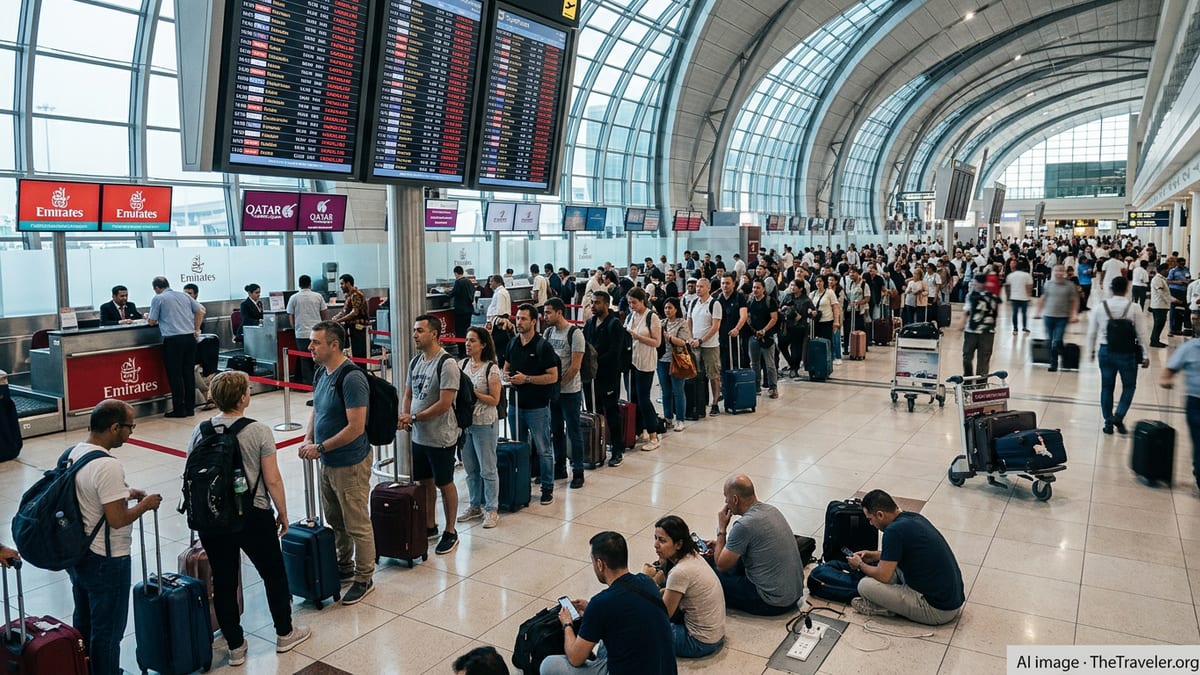
Industry guidance is clear: passengers should refrain from going to the airport unless they possess a confirmed, rebooked itinerary and have been directly informed by their airline. Airport terminals throughout the Gulf have recently become overwhelmed with stranded travelers, resulting in individuals sleeping on floors and enduring lengthy wait times at service counters—an outcome that airlines and authorities aim to prevent as limited flights resume.
Travelers needing to transit through Dubai, Abu Dhabi, or Doha in the coming days should be prepared for significant disruptions. Even when flights are technically operating, schedules may be unpredictable, and last-minute cancellations are likely due to ongoing military activities and changing airspace conditions. However, many airlines are waiving change fees, although rebooking options may be limited due to reduced capacity on alternative routes that avoid the Gulf.
Those who have yet to travel are advised to explore rerouting through alternative hubs, such as those in Europe or Southeast Asia, or to delay nonessential trips altogether. Some long-haul routes that typically depend on Gulf connections may have no feasible alternatives until further airspace opens.
Safety, Rerouting, and Passenger Rights
Despite the chaos, safety remains paramount in every operational decision. Airlines are collaborating closely with national aviation authorities and military entities to establish “safe corridors” for flights to navigate through restricted areas. This often results in longer flights, unusual rerouting far from conventional paths, and potential mid-journey diversions if risks change.
For travelers, the visual impacts of this may be significant: flight maps displaying substantial detours around the Gulf, delayed arrivals, and aircraft overnighting at unexpected destinations. Flight crews must also adhere to duty-time regulations, which may necessitate unscheduled layovers and further delays even after a safe route has been determined.
When it comes to compensation, travelers should set realistic expectations. The disruption stems from armed conflict and government-mandated airspace closures, which typically fall into the category of extraordinary circumstances outside airline control. As a result, entitlement to cash compensation under most consumer protection laws is often restricted, although airlines are providing refunds, allowing free changes of travel dates, and in some instances, offering hotel accommodation for stranded passengers when feasible.
Experts recommend that travelers retain all documentation, including cancellation notices and receipts for any additional expenses, and maintain communication with their airline or travel agent. Comprehensive travel insurance covering war-related disruptions is uncommon, but some policies may still reimburse certain costs related to delays, missed connections, or enforced stopovers, depending on their specific terms.
Duration of the Disruption and Future Outlook
The duration of the disruption is closely tied to developments in the conflict. Aviation authorities have emphasized that airspace will only fully reopen when they are assured that the threat level from missiles, drones, and potential collateral attacks has diminished to an acceptable threshold. Even then, the reopening will likely be gradual, prioritizing evacuation flights, cargo operations, and a minimal network of commercial services.
Emirates has indicated its intention to restore near-normal capacity in the coming days, contingent on security conditions, while Etihad is adopting a more cautious approach with a limited schedule tailored to key markets. Qatar Airways faces a more prolonged path to normal operations due to the ongoing closure of Qatari airspace, although limited relief corridors are beginning to emerge under stringent oversight.
Travel analysts caution that, beyond immediate humanitarian and logistical hurdles, the war could hinder the Gulf’s well-established reputation as a reliable transit point between continents. Forecasts suggest that international arrivals to the broader region may drop significantly this year if travelers and tour operators view the skies over the Middle East as unstable, even after official restrictions are lifted.
For the time being, anyone planning to travel through Dubai, Abu Dhabi, or Doha in the forthcoming weeks should brace for a dynamic situation. Flight schedules will likely change at short notice, routings may be atypical, and airlines will continuously navigate the competing demands of safety, regulatory requirements, and the considerable demand from stranded travelers seeking to return home.