

Australia’s long-held ambition for high-speed rail is becoming more tangible as the federal government introduces plans for a one-hour link between Newcastle and Sydney. This initiative aims to revolutionize the daily lives, work, and travel habits of millions along the country’s busiest route.
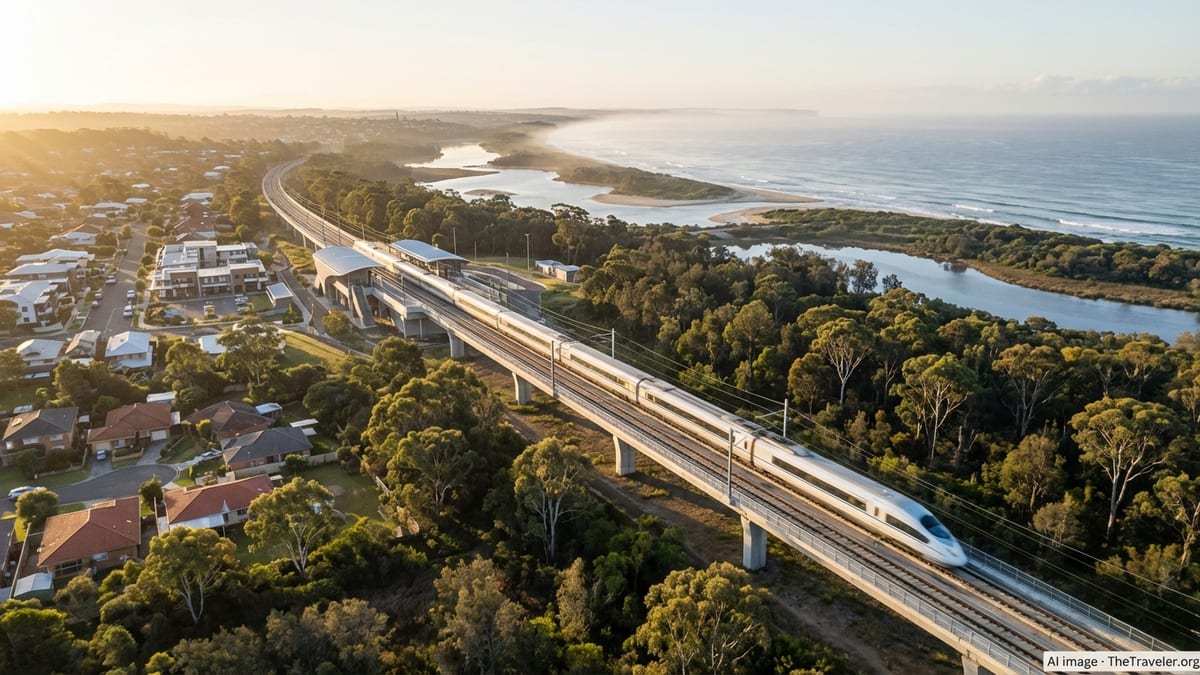
A Nation-Defining Rail Corridor Takes Shape
The Albanese administration has confirmed a significant new phase for Australia’s inaugural high-speed rail line, marking the Newcastle to Sydney corridor as the first step toward an expansive east coast network. The goal is to reduce current rail travel times from over two and a half hours to approximately 60 minutes, making this route a pilot project for high-speed rail implementation nationwide.
Trains are anticipated to reach speeds of up to 320 kilometers per hour on certain segments, providing fast, frequent, and comfortable service connecting Newcastle, the Central Coast, and Sydney. The High Speed Rail Authority has been tasked with developing a comprehensive business case to prepare for construction later this decade.
Federal Infrastructure Minister Catherine King has characterized this line as a transformative investment, suggesting that high-speed rail will foster closer connections between people and places while alleviating pressure on housing and infrastructure. Officials have prioritized the Newcastle to Sydney segment due to its expected economic benefits, rapid travel time reductions, and potential for significant regional growth.
Two-Year Development Push and Multi-Billion-Dollar Price Tag
The latest announcement includes an additional investment of 229.6 million Australian dollars for planning and design, raising the total federal commitment to approximately 659.6 million dollars for this phase. In the coming two years, engineers and planners will meticulously refine station locations, tunnel layouts, and technical specifications prior to any major contracts being awarded.
This crucial phase aims to secure the rail corridor, complete at least 40 percent of the design work, and establish a realistic cost estimate for what is expected to be a multi-billion-dollar megaproject. Government documents and media updates suggest that building the line alone could total tens of billions of dollars, with the comprehensive project—including trains, signaling, and supporting infrastructure—potentially costing significantly more.
Officials believe that conducting this thorough groundwork will help minimize the risks of cost overruns and delays once construction starts. A final investment decision is currently planned for 2028, with the government considering a mix of public funding and private investment to back what is likely to be one of Australia’s most expensive transport projects in history.
From Congested Commute to One-Hour City Link
At the core of this project is a significant overhaul of daily travel between Newcastle, the Central Coast, and Sydney. The High Speed Rail Authority’s forecasts suggest a journey from Newcastle to Central Sydney could be completed in around one hour, a marked improvement compared to the current train trips that typically exceed two and a half hours due to the busy and winding coastal routes.
Travel times from the Central Coast to either Sydney or Newcastle are expected to decrease to roughly 30 minutes, thus significantly reducing perceived distances across the area. Initial plans propose a new high-speed route of approximately 190 kilometers, featuring substantial tunnel sections under waterways and bushland, along with new or upgraded stations in vital growth areas like Broadmeadow and the Central Coast.
Officials assert that the line is being designed as the first segment of a broader east coast network that will connect Brisbane, Sydney, Canberra, and Melbourne. Consequently, decisions regarding track layout, tunnel specifications, and rolling stock are being made with future long-distance express services in mind, even as the primary focus remains on catering to commuters between Newcastle and Sydney.
Economic Windfall and Housing Shock Absorber
The business case backing the rail line estimates that the Newcastle-Sydney high-speed connection could contribute around 250 billion dollars to the Australian economy over the next 50 years. Government projections indicate that the construction and ongoing operation will create over 99,000 jobs in construction, advanced manufacturing, engineering, and other sectors throughout the project’s lifespan.
In addition to direct job creation, policymakers view the project as a powerful tool for altering population growth patterns. Improved connections to Sydney are expected to facilitate new housing opportunities in Newcastle, the Hunter region, and the Central Coast by making longer-distance commuting more feasible. This shift could attract residents who are priced out of the major capital while still enabling access to metropolitan employment and services.
Tourism operators are also paying close attention, as a one-hour link offers city visitors a convenient route between Sydney and the beautiful beaches, wineries, and cultural attractions of the Hunter region. Business groups emphasize that this line will contribute to establishing a single, integrated labor market within a corridor that already plays a vital role in New South Wales’ economic activity.
Timelines, Skepticism, and the Long Road Ahead
Despite the excitement surrounding the envisioned one-hour travel time, the government has been cautious in managing expectations, emphasizing that passengers will not be able to board high-speed trains immediately. The two-year development phase will precede a final investment decision, with construction contracts anticipated to occur later this decade, and phased openings expected to extend into the 2030s and 2040s.
Initial timelines suggest that high-speed services might first connect Newcastle and the Central Coast, while the final segment reaching inner Sydney will require additional time due to complex tunneling and urban planning challenges. Extensions toward Parramatta and the Western Sydney Airport are also under consideration as part of a broader long-term network strategy.
The ambitious scope and timeline of this project have reignited skepticism among some, particularly given Australia’s history of incomplete high-speed rail proposals. Critics question the feasibility of maintaining cost projections and whether political support can endure through government changes and economic fluctuations. Supporters, however, point to the establishment of a dedicated High Speed Rail Authority, a solid business case, and substantial initial funding as evidence of a more serious commitment than in previous attempts.
For the time being, the government hopes that the prospect of a one-hour journey between Newcastle and Sydney will transition discussions from mere aspirations to tangible outcomes, transforming high-speed rail from a political slogan into a practical reality and providing a framework for how Australia might finally embrace fast intercity travel.



