Retiring in El Salvador now attracts attention for reasons that would have seemed unlikely only a few years ago. Violent crime and gang activity have fallen dramatically, the U.S. dollar removes everyday exchange-rate friction, new roads and coastal development are changing parts of the country, and foreign Salvadorans are returning with capital and experience.
The country is compact but remarkably varied. A retiree can live near private hospitals in the San Salvador metropolitan area, among coffee towns on the Ruta de las Flores, beside Lake Coatepeque, in colonial Suchitoto or near the Pacific surf communities of La Libertad. Each option carries a different balance of climate, medical access, walkability, cost and property pressure.
El Salvador’s improved security deserves recognition, but a complete guide must also explain the continuing State of Exception, broad detention powers, road hazards, weak rural emergency care and fast-rising prices in popular coastal areas. The goal is not to sell a trend. It is to build a retirement plan that remains workable after the excitement fades.
El Salvador Retirement at a Glance
| Planning question | Practical answer |
|---|---|
| Tourist entry | No visa generally required for stays of 90 days or less; CA-4 regional clock applies |
| Pensioner residence | Definitive residence available under the Special Migration and Foreigners Law |
| Reported income | About $1,095 pensionado and $1,460 rentista monthly; verify current indexed amount |
| Tax residence | More than 200 consecutive days or principal income source in El Salvador can matter |
| Tax system | Source-based/territorial principles; classification of services and local income is critical |
| Currency | U.S. dollar for practical daily use |
| Healthcare | Best private care in the San Salvador metropolitan area |
| Current advisory | Level 1, with special legal caution due to the continuing State of Exception |
Why Retire in El Salvador?
El Salvador is the smallest country in mainland Central America, slightly smaller than Massachusetts. That compact geography makes it possible to reach hospitals, beaches, volcanoes, colonial towns and the international airport without the all-day journeys common elsewhere. The country uses Central Standard Time year-round and does not observe daylight saving time.
The U.S. dollar is the day-to-day currency, reducing exchange confusion for Americans and people whose pensions are dollar-denominated. Mobile service and fiber internet have improved in major communities. Food markets, domestic help and local restaurants can remain affordable, though imported goods, international insurance and premium housing are not cheap.
Why retirees are interested
- Level 1 U.S. travel advisory as of June 2026
- U.S. dollar used for ordinary transactions
- Warm Pacific coast and cooler volcanic highlands
- Short distances between airport, capital and coast
- Definitive residence categories for pensioners and rentistas
- Growing restaurant, tourism and international community
- Private hospitals and specialists around San Salvador
What still requires planning
- State of Exception and broad detention powers
- Poor night visibility and rainy-season landslides
- Limited advanced healthcare outside the capital
- Riptides and dangerous Pacific swimming conditions
- Rapid price growth in coastal development zones
- Earthquakes, volcanoes, tropical storms and flooding
- Spanish needed for independent daily life
Geography, History and Culture
El Salvador faces the Pacific Ocean and borders Guatemala and Honduras. A chain of volcanoes defines the landscape. The coastal plain is hot and humid, while higher communities around San Salvador, Santa Ana, Juayúa and Apaneca are cooler. Lake Coatepeque fills a volcanic caldera, and the country’s black-sand beaches reflect its geology.
Pipil and Lenca peoples lived in the region before Spanish conquest. The archaeological sites of Joya de Cerén, Tazumal and San Andrés preserve different parts of pre-Columbian life. El Salvador declared independence from Spain in 1821 and later left the Federal Republic of Central America.
The twentieth century included extreme inequality, repression and a civil war from 1980 to 1992. The peace accords ended the formal conflict, but migration, gangs and institutional weakness shaped later decades. Since 2022, a State of Exception and large-scale detentions have transformed public security and everyday perceptions of safety. This recent history remains politically sensitive and should be approached respectfully.
Spanish is essential. Pupusas, corn, beans, seafood and tropical produce anchor the food culture. Town festivals, religious processions, markets, artisan work and coffee production create regional identity. Salvadorans abroad maintain strong family and financial connections, and return migration influences property and business.
Climate and the Best Scouting Season
The dry season usually runs from November through April. The rainy season, commonly May through October, brings heavy afternoon or evening rain, flooding and landslide risk. The coast remains hot throughout the year, while elevation makes the highlands noticeably more comfortable.
A first trip is easiest in the dry season, but a final housing choice should be tested during rain. Inspect roof leaks, retaining walls, drainage, mold, road slope, backup power and water storage. A house that feels breezy in January may become humid and difficult in September.
Earthquakes are part of life, and volcanic activity requires attention to official alerts. Coastal households also plan for tropical storms, salt corrosion and evacuation routes. Retirees should know the civil-protection shelter and the safest interior area of the home.
Tourist Entry and the CA-4 Clock
U.S. citizens generally do not need a visa for stays of 90 days or less. A passport must be valid at entry, although longer validity is a safer planning standard. Proof of onward travel, accommodation and funds may be requested. Yellow fever vaccination is required when arriving from certain affected countries.
El Salvador belongs to the CA-4 border agreement with Guatemala, Honduras and Nicaragua. The 90-day period is generally shared across all four countries, not restarted at every border. A one-time extension may be requested from the local immigration authority. Retirement should never depend on repeated border runs.
Travelers entering or leaving with more than the reportable amount of currency must follow declaration rules; the State Department currently lists $10,000 as the entry and exit maximum without the relevant procedures. Keep lawful proof of funds and transfers.
Pensionado and Rentista Residence
The Special Migration and Foreigners Law provides definitive residence for qualifying pensioners and rentistas. A Pensionado generally proves a stable government or private pension; a Rentista proves recurring income from accepted investments, rentals or other independent sources.
Recent practitioner guides commonly quote approximately US$1,095 per month for pensioners and US$1,460 per month for rentistas. These figures may be connected to wage-indexed formulas and can change. In March 2026, lawmakers were considering migration reforms designed for newer profiles of investors and businesspeople. Obtain the current category, income, dependent amount, fee and physical-presence rule in writing from the Dirección General de Migración y Extranjería.
Typical application preparation
- Passport with sufficient remaining validity and complete copies
- Birth and marriage records when applicable
- Police or criminal-record certificates from relevant countries
- Official pension or recurring-income letter
- Proof of payment history and banking access
- Health documentation if required for the category
- Apostilles or accepted authentication
- Spanish translations by an accepted professional
- Dependent relationship evidence and extra income
- Application, photographs, local address and government fees
Document validity windows can be short. Confirm requirements before ordering records. Match names and dates across every document. Use a licensed Salvadoran lawyer who represents only you, provide a written scope and obtain receipts for every government payment and original.
Definitive residence still requires refrenda, an endorsement or renewal of the residence card. The migration authority states it can be handled for periods from one to four years with corresponding fees. Ask about absence rules; long periods abroad can affect a pensioner or rentista status.
Tax Residence, Territorial Tax and U.S. Obligations
El Salvador uses source-based principles. Foreign-source income can fall outside Salvadoran income tax, but source classification matters more than the payer’s address. A retiree receiving a pension abroad may have a different outcome from a consultant performing work from a beach house for foreign clients.
An individual is commonly treated as tax resident when living in the country for more than 200 consecutive days during a calendar year or when the principal source of income is in El Salvador. Immigration status does not automatically decide tax status. Local rent, services, a business, interest and gains need separate analysis.
U.S. citizens and resident aliens generally continue U.S. filing on worldwide income. El Salvador does not appear on the IRS list of U.S. income-tax treaties. Foreign tax credits, FBAR, Form 8938, state domicile and company reporting may apply. Get coordinated U.S. and Salvadoran advice before changing residence or selling investments.
Bitcoin without the sales pitch
El Salvador’s Bitcoin policy made international headlines, and some property or tourism businesses advertise crypto payments. Retirement planning should not depend on price appreciation or a merchant’s willingness to accept a volatile asset. Use the U.S. dollar for the base budget, maintain regulated bank access, understand tax basis in the country of citizenship and use licensed intermediaries for large property transactions.
Keep primary savings diversified outside El Salvador. Maintain at least two cards and multiple ways to receive money. Local banks may request source-of-funds documentation. Compare wire fees, ATM limits and account requirements before relying on one institution.
Cost of Living in El Salvador
El Salvador remains less expensive than many U.S. locations, but it is not uniformly cheap. Coastal development near El Tunco, El Zonte and Surf City has pushed land, restaurants and rent upward. San Benito, Escalón, Santa Elena and Antiguo Cuscatlán command metropolitan premiums. Secondary highland towns can offer better value.
| Monthly category for two | Planning range (US$) | What changes it |
|---|---|---|
| Long-term rent | $650–$1,800+ | Metropolitan security, ocean view, furnishings and new construction |
| Utilities and communications | $150–$380 | Air-conditioning, water storage, generator and internet redundancy |
| Food and household supplies | $450–$900 | Local markets versus imported goods and restaurants |
| Transport | $200–$750 | Driver and ride apps versus owning and insuring a vehicle |
| Healthcare and insurance | $250–$1,200+ | Age, conditions, deductibles and evacuation coverage |
| Leisure and help | $250–$750 | Dining, beach trips, domestic help and travel |
| Emergency reserve contribution | $200–$500 | Medical transfer, flights and temporary relocation |
A couple living locally in Santa Ana, Suchitoto or a highland town might target US$1,900–$3,000 monthly. A secure metropolitan or premium beach lifestyle with a car, international insurance and imported food can reach US$3,000–$5,000 or more. These are planning bands, not quotations.
First-year costs include deposits, furniture, residence documents, apostilles, translation, professional fees and insurance underwriting. Electricity for air-conditioning, coastal corrosion, water systems and vehicle import duties can surprise newcomers. Maintain a 15–20 percent contingency.
Best Places to Retire in El Salvador
San Salvador metropolitan area
The metropolitan area provides the country’s best hospitals, specialists, shopping, restaurants and professional services. Popular foreign-resident zones include parts of San Benito, Escalón, Santa Elena, Antiguo Cuscatlán and Santa Tecla. Traffic can make a short distance take an hour, so choose housing around hospital and grocery routes rather than prestige alone.
Santa Tecla and Antiguo Cuscatlán
These metropolitan municipalities appeal to retirees who want newer development, dining and access to San Salvador while avoiding the center. Elevation can provide a slightly milder climate. Rent and condominium fees can be high, and walkability varies by neighborhood.
La Libertad, El Tunco and El Zonte
The Pacific coast offers surf culture, seafood and fast access to the airport and capital. Development has raised prices, and some areas are noisy or oriented toward weekend tourism. Powerful riptides make casual ocean swimming dangerous. Choose a home above flood exposure with drainage, corrosion-resistant systems and a reliable medical route.
Suchitoto
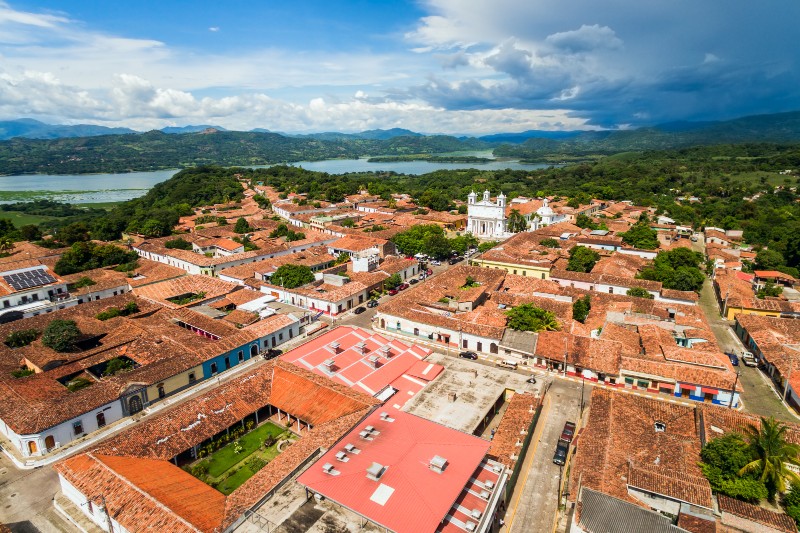
Suchitoto offers cobbled streets, art, indigo traditions and views over Lake Suchitlán. It feels slower and more culturally grounded than the coast. Retirees should test heat, hills, local healthcare and travel time to the capital.
Santa Ana and Lake Coatepeque
Santa Ana is a major western city with markets, hospitals and a historic center. It provides access to Tazumal, coffee highlands, Santa Ana Volcano and Lake Coatepeque. Lake homes can be costly and car-dependent; slope stability, septic systems, water quality and legal access are essential checks.
Ruta de las Flores
Juayúa, Apaneca, Ataco and nearby coffee towns provide cooler air, mountain scenery, festivals and weekend markets. They appeal to retirees seeking a smaller community. Specialist healthcare, nighttime road travel and rainy-season landslides are the main trade-offs.
San Miguel and the east
San Miguel is the eastern commercial center with hot weather, regional healthcare and access to beaches and volcanoes. It is less internationally oriented than San Salvador or La Libertad. Test climate tolerance and specialist needs carefully.
| Location | Best for | Main compromise | Medical strategy |
|---|---|---|---|
| San Salvador metro | Hospitals, services and airport access | Traffic and higher rents | Live near chosen hospital |
| La Libertad coast | Beach and international community | Price, heat, riptides and tourism | Capital transfer plan |
| Suchitoto | Culture and small-town rhythm | Hills and fewer specialists | Routine local care; capital referrals |
| Santa Ana | City value and western attractions | Heat and varying infrastructure | Regional care plus San Salvador backup |
| Ruta de las Flores | Cooler coffee-country living | Rainy roads and limited care | Evacuation coverage |
| San Miguel | Eastern city services | Very hot climate | Regional hospital and capital plan |
Famous Places and Retirement Adventures
Santa Ana Volcano and Cerro Verde offer dramatic views over volcanic country, while Lake Coatepeque provides boating and lakeside restaurants. Hikes should use authorized guides and official access information. Fitness, heat and trail conditions matter more in retirement than a promotional photo suggests.
Joya de Cerén preserves a Maya farming village buried by volcanic ash and is often compared to Pompeii for the intimacy of everyday remains. Tazumal and San Andrés broaden the archaeological story. Suchitoto offers indigo workshops, galleries and cultural festivals.
The Ruta de las Flores connects coffee towns, markets and mountain scenery. The Pacific coast has world-class surfing, but retirees should respect warning flags and riptides. Inland waterfalls and lakes also carry drowning risk; use local guidance rather than assuming calm-looking water is safe.
Healthcare, Insurance and Medical Evacuation
Private hospitals and specialists are concentrated around San Salvador. Urban care can be good for routine and many complex conditions, but facilities and English decline outside the capital. Public clinics may lack basic resources, and psychological or psychiatric services are limited.
Private hospitals often request upfront payment or proof of accepted insurance. The U.S. advisory notes billing complaints and states that patients cover transfer costs. Original Medicare and Medicaid generally do not pay abroad. Keep a medical credit line or cash reserve even with insurance.
Compare international policies for pre-existing conditions, cancer surveillance, prescription drugs, age renewal, direct billing, deductible, evacuation destination and repatriation. Evacuation may mean the nearest appropriate facility, not automatically a preferred U.S. hospital.
CDC-linked guidance recommends routine vaccines plus hepatitis A and typhoid for travelers, with hepatitis B based on risk. Yellow fever proof can be required when arriving from specified countries. Dengue and other mosquito-borne illnesses make screens, repellent and standing-water control important.
Carry medication in original packaging with a prescription and generic name. THC products, including many CBD preparations, are illegal. Counterfeit medicines are a concern, so use established pharmacies and physician guidance. Ambulances are limited and may lack advanced equipment; identify the fastest reliable transport to a selected hospital.
Renting and Buying Property
Rent for six to twelve months before buying. Security, traffic, weekend noise, water service, air-conditioning cost and rainy-season drainage change the experience of a property. A coastal home needs a different maintenance budget from a highland apartment.
Foreigners can generally own urban real estate under reciprocity principles, but rural land, agricultural acreage and property near borders or coasts require constitutional analysis. Do not rely on a developer’s summary. Use an independent Salvadoran attorney and surveyor.
- Verify ownership and encumbrances in the property registry.
- Trace prior transfers and confirm the seller’s authority.
- Compare registry description, cadastral map and physical boundaries.
- Check legal road access, utilities, water rights and septic approval.
- Review zoning, construction permits and coastal/environmental limits.
- Inspect structure, retaining walls, drainage and earthquake resistance.
- Confirm condominium fees, reserves, rules and special assessments.
- Use documented banking and closing procedures for funds.
Bitcoin or tokenized payment does not replace title due diligence, anti-money-laundering checks or tax reporting. Buying real estate also does not automatically grant residence. Keep the immigration and property decisions separate.
Safety, the State of Exception and Transportation
El Salvador’s current Level 1 U.S. advisory is a major change. Gang activity, murders and violent crime have fallen sharply. Many residents report freedom of movement that was previously impossible. Retirees should recognize that improvement without ignoring the legal mechanism behind it.
The State of Exception, introduced in March 2022, remains in place as of the June 2026 advisory. It suspends some protections of ordinary criminal procedure and permits authorities to arrest people suspected of gang involvement. Tens of thousands remain detained awaiting trial, and some U.S. citizens have been detained. Avoid gang-related symbols, confrontations and any assumption that foreign citizenship guarantees rapid release.
Robbery, vehicle theft and assault still occur. Use secure parking, limit visible valuables and remain alert at banks and ATMs. Avoid demonstrations. Police emergency is 911 and ambulance is 132. Save the U.S. Embassy number, +503-2501-2999.
Do not drive after consuming any alcohol: El Salvador applies zero tolerance and criminal penalties. Avoid intercity night driving because of poor lighting, hills, road conditions and landslides. Public buses are not an appropriate default for foreign retirees concerned with safety; use vetted drivers, established ride services and major roads.
Daily Life, Utilities and Community
The dollar simplifies pricing, but cash remains important because some merchants do not accept cards or add fees. ATMs may be out of service or expensive. Carry limited cash in separate places and maintain multiple payment methods.
Inspect water storage, pumps, filtration, electrical grounding, internet and mobile signal at a prospective home. Coastal homes need air-conditioning, dehumidification and corrosion maintenance. A medical-device user needs backup power. Remote workers need a second internet path.
Spanish is necessary for true independence. Learn medical terms, housing vocabulary and emergency phrases. International groups are growing around the capital and coast, but churches, volunteer organizations, classes, markets and local clubs create more durable community.
El Salvador is socially conservative in many areas. Same-sex sexual activity is legal, but discrimination and uneven protections remain concerns. Retirees of all identities should research the actual municipality and neighborhood rather than treating the country as culturally uniform.
Aging in Place and Estate Planning
A beach or volcano-view property may involve stairs, steep access and long hospital transfers. Choose a home with a bedroom and accessible bathroom on the entry level, safe railings, vehicle access and room for a caregiver. Confirm that an ambulance can physically reach it.
Domestic help is different from skilled nursing. Identify who could manage medications, mobility or dementia, and whether family can reach El Salvador quickly. Create a medical summary in English and Spanish.
Use Salvadoran and home-country counsel for wills, healthcare directives and powers of attorney. Cross-border homes, corporations, bank accounts and heirs can create probate conflicts. Store copies of passports, residence cards, insurance, medication, title or lease and emergency contacts securely outside the country.
A 12-Month El Salvador Move Plan
| Timing | Action | Decision test |
|---|---|---|
| 12–10 months | Compare residence categories, advisory, insurance and three regions | Are you comfortable with the State of Exception and legal environment? |
| 10–8 months | Scout capital, coast and one highland location in the dry season | Which location works for hospitals and daily errands? |
| 8–6 months | Obtain current migration figures and cross-border tax advice | Does your exact pension or income qualify? |
| 6–4 months | Return during rain, price insurance and collect time-sensitive documents | Does the property remain accessible, dry and secure? |
| 4–2 months | Sign a long rental and preserve outside banking and healthcare options | Can the move be reversed without a distressed sale? |
| Move month | Arrive lightly, record entry and application receipts, activate emergency plan | Are funds and documents redundant? |
| Months 1–6 | Establish doctors, language, transport and community | Can the town manage your most likely emergency? |
| Months 7–12 | Review actual budget, taxes and residence compliance before buying | Would you choose the same location after both seasons? |
Common mistakes
- Assuming Level 1 means no legal or ordinary crime risk.
- Using an unverified Pensionado income figure during 2026 reforms.
- Buying coastal property before testing weekend noise and rainy-season access.
- Treating Bitcoin marketing as financial or title due diligence.
- Driving between cities after dark or after any alcohol.
- Underestimating riptides and unguarded beaches.
- Relying on Medicare or one local hospital.
- Confusing the CA-4 regional clock with a new 90 days at every border.
- Ignoring heat, stairs and specialist access when planning to age in place.
- Performing remote work without tax and immigration analysis.
Is El Salvador Right for Your Retirement?
El Salvador can fit an adaptable retiree who wants dollar-based living, warm weather, easy North American access and an energetic country undergoing rapid change. The strongest candidate speaks Spanish, rents first, carries robust health coverage and keeps most wealth diversified abroad.
It may not fit someone uncomfortable with the State of Exception, dependent on highly specialized care, unable to tolerate heat or hills, or determined to buy a premium beach home immediately. Improved security does not eliminate institutional, medical or property risk.
Test the country in stages. Compare El Salvador with Guatemala, Costa Rica, Nicaragua, Mexico and other choices through the main retirement guide directory.
Frequently Asked Questions
Can a U.S. citizen retire in El Salvador?
Yes. U.S. citizens may generally enter without a visa for stays of 90 days or less, and Salvadoran law provides definitive residence categories for qualifying pensioners and rentistas. Tourist admission and residence are separate processes.
How much income is required for El Salvador Pensionado residence?
Recent immigration guides commonly report about US$1,095 per month in qualifying pension income. Rentista figures are often reported around US$1,460 monthly. Because the amounts are linked to rules that can change and migration reforms were under discussion in 2026, obtain the current written requirement from the migration authority before filing.
Is El Salvador safe for retirees in 2026?
The U.S. State Department currently rates El Salvador Level 1—Exercise Normal Precautions—and reports a dramatic decline in gang activity and violent crime since 2022. However, the State of Exception remains in force, suspending some criminal-procedure protections, and some U.S. citizens have been detained.
What are the best places to retire in El Salvador?
San Salvador and nearby Santa Tecla or Antiguo Cuscatlán offer the strongest hospitals and services. Suchitoto offers colonial culture; the Ruta de las Flores offers cooler highland towns; Santa Ana has city services near volcanoes and Lake Coatepeque; and La Libertad offers beach living at higher prices and with ocean-safety concerns.
Does El Salvador tax foreign retirement income?
El Salvador generally follows source-based or territorial principles, but foreign payment does not automatically mean foreign-source. Services performed in El Salvador, local rent and local business activity may be taxable. Obtain advice for each income stream.
When am I considered an El Salvador tax resident?
A commonly cited rule treats an individual as resident after more than 200 consecutive days in the country during a calendar year, or when the person has a principal source of income in El Salvador. Immigration and tax residence are separate analyses.
Is there a U.S.–El Salvador income-tax treaty?
El Salvador does not appear on the IRS list of U.S. income-tax treaties. U.S. citizens and resident aliens generally continue reporting worldwide income and may have foreign-account reporting obligations.
Can foreigners buy real estate in El Salvador?
Foreigners can generally acquire urban property, subject to reciprocity and constitutional rules. Rural land, coastal or border locations, agricultural limits and title history require independent Salvadoran legal review. Buying property does not itself grant residence.
Does Medicare work in El Salvador?
Original Medicare and Medicaid generally do not cover care in El Salvador. Private hospitals may require payment or accepted insurance before treatment, so international coverage, accessible funds and evacuation protection are important.
Does El Salvador use the U.S. dollar or Bitcoin?
The U.S. dollar is the practical official currency for daily life. Bitcoin has a legal and policy history in El Salvador, but retirees should not assume every merchant accepts it or that crypto transactions are risk-free. Maintain ordinary banking and cash access.
Can I drink tap water in El Salvador?
Water safety varies by location and property. Many residents and foreigners use sealed bottled, boiled or properly filtered water. Inspect tanks, pumps and filtration at a specific home and follow current local health guidance.
When is the best time to scout El Salvador?
The dry season from roughly November through April is easiest for travel. A serious retirement decision should include rainy-season testing because landslides, drainage, roof leaks, road access, humidity and power reliability become more visible.
Official and Planning Resources
- El Salvador migration authority
- U.S. State Department El Salvador advisory
- U.S. Embassy in El Salvador
- El Salvador Ministry of Foreign Affairs
- CDC El Salvador traveler health
- El Salvador Ministry of Finance
- El Salvador Civil Protection
- IRS income-tax treaty list
Explore More Retirement Guides
Compare El Salvador with every completed Investing Travels guide:
Americas
Europe and all destinations
Browse all published and upcoming destinations.
Retirement Guides by CountryTags: El Salvador retirement, retire in El Salvador, retiring in El Salvador, moving to El Salvador, El Salvador expat guide, El Salvador Pensionado, El Salvador Rentista, El Salvador residency, San Salvador retirement, La Libertad retirement, El Salvador healthcare, El Salvador cost of living, retirement abroad